
The Reserve Bank of India on Friday revised upwards the GDP growth projection for the current fiscal to 7.2 per cent from 7 per cent on rising private consumption and revival of demand in rural areas. Unveiling the bi-monthly monetary policy, RBI Governor Shaktikanta Das said estimates released by the National Statistical Office (NSO) placed India's real gross domestic product (GDP) growth at 8.2 per cent in 2023-24. "During 2024-25 so far, domestic economic activity has maintained resilience," he said, adding that manufacturing activity continues to gain ground on the back of strengthening domestic demand.

This period of strong growth not only offers opportunities but also calls for strategic considerations to ensure sustainable development and equitable prosperity in the years to come, suggests Sujan Hajra.

India's inclusion in JP Morgan's bond index can channel billions of dollars into India. How will the government securities market handle it?
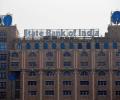
In order to boost its deposit base, State Bank of India (SBI) is focusing on various segments, including JanDhan account holders, trusts, societies, and the segment below the affluent class but above the normal account holders. According to Ashwini Tewari , managing director, SBI, the bank is focusing on three broad segments. One is wealth banking, where the bank is focusing on individuals who perhaps do not qualify for private banking but are above regular accounts and require individual attention.

Indian states are preparing for a Rs 1.9 lakh crore (Rs 1.9 trillion) tax windfall this fiscal year.

Gadkari said, infrastructure sector including highways, airports, inland waterways, railways, logistic parks, broad gauge and metro, apart from MSMEs can attract large scale foreign investment.

'In the new coalition government, India's reform agenda may prioritise job creation and factor market reforms.'

The third-quarter financials didn't excite market watchers. But equity investors can still make money if they invest in the right stocks.

To boost domestic manufacturing under the Make in India initiative and reduce dependency on imports, the government is expected to announce in the Budget an increase in the minimum local content requirement for public procurement, with certain sectors being granted exceptions. Currently, firms producing goods, services, or works with at least 50 per cent local content are classified as Class-I local suppliers and are preferred the most in government procurement.

Global private equity (PE) firms are successfully offloading large equity stakes in domestic companies in the open market, taking advantage of buoyant conditions. Strong domestic liquidity support and an upward trending market have underpinned over a dozen PE exits worth $2.5 billion, data compiled by Business Standard shows. The figures exclude PE exits during maiden share sales and shares sold by strategic investors, such as SoftBank and Ant Group in new-age companies.

This includes an infrastructure push which may lead to the government spending more than its budgeted capital expenditure for 2020-21. There are also discussions on increasing the scope and quantum of direct cash transfers to the beneficiaries who need it the most.
.jpg)
Amid the top 20 states, Kerala is the only state which witnessed a surge in the proposed investments at 10 per cent with two projects worth over Rs 14,200 crore (Rs 142 billion).

According to Rajnish Kumar, the government investments alone cannot achieve it and there is a need for huge investments in the infrastructure sector which would result in boosting the GDP.

Following are comments from economists at leading financial institutions, banks and rating agencies on the interim Budget:

The government will formulate a strategy to make India self-reliant in edible oils by boosting domestic output of oilseeds and launch a comprehensive programme to support dairy farmers, Finance Minister Nirmala Sitharaman announced on Thursday. India imports a large quantity of edible oils to meet the domestic demand. During the 2022-23 marketing year (November-October), the country imported nearly 165 lakh tonnes of cooking oils, valuing a whopping Rs 1.38 lakh crore.

India's economy is projected to slow to 6.5 per cent in the fiscal year starting April but will remain the fastest growing major economy in the world as it fared better in dealing with the extraordinary set of challenges the globe has faced, the Economic Survey 2022-23 said on Tuesday. India's gross domestic product (GDP) growth of 6.5 per cent in 2023-24 compares with an estimated 7 per cent expansion in current fiscal year (April 2022 to March 2023) and 8.7 per cent in the previous year. Like the rest of the world, India too faced an extraordinary set of challenges in tightening financial conditions and supply chain disruptions from a prolonged war in Europe but "withstood them better than most economies", the annual document detailing the state of the economy said.

Even if no statistical jugglery is afoot, only to warn that the 'noise' in the numbers should be eliminated in order to hear the underlying music, without distortion, warns T N Ninan.

The government may double to ten per cent the ceiling of retirement funds managed by private organisations for investing in listed companies, a move that could further boost the already bullish stock markets. The finance ministry is likely to take a final decision next week on allowing private provident funds, superannuation funds and gratuity funds to invest up to 10 per cent of their funds in listed shares.
At present, the EPFO is mandated to invest 20-45 per cent of its incremental funds - of around Rs 1.5 trillion - in debt-related instruments.

'Tax cuts will have only marginal effects in the short run and significant positive effects in the medium term,' says Shankar Acharya, former chief economic adviser to the Government of India.

For over a decade, HDFC Bank consistently outperformed industry growth rates in both deposits and advances, maintaining impeccable asset quality. Amid a landscape where other banks struggled with soaring non-performing assets (NPAs), HDFC Bank thrived, eventually surpassing ICICI Bank to become the largest private sector lender in India. Its net interest margin (NIM) remained stable in the range of 4.1-4.4 per cent.

The Centre plans to create a special window for strategically important investors such as sovereign wealth funds and pension funds that wish to invest over Rs 3,000 crore through a single transaction.

India needs to revive corporate sector investment, push critical reforms and remove infrastructural bottlenecks to boost industrial growth in the country, says a government document.

India and the US on Monday committed to further improving bilateral ties, exploring alternate mechanisms for funding renewable energy and actively pursuing the G20 agenda which includes strengthening MDBs and taking coordinated action to deal with climate change. Several issues, including climate action, rising indebtedness in low and middle income countries and digital public infrastructure, figured during a bilateral meeting between Finance Minister Nirmala Sitharaman and US Treasury Secretary Janet Yellen held on the sidelines of the G20 meeting of Finance Ministers and Central Bank Governors. India, Sitharaman said, will "look forward to furthering ... bilateral interests through development cooperation and new investment opportunities through Alternate Investment platforms for renewable energy."

'There are deliberations on whether there can be lowering of income taxes and other sops to keep more money in the hands of taxpayers, enabling them to spend more and boost demand.'

Prime Minister Modi will hold in-person meetings with President Putin for 8-9 hours during his nearly 24-hour stay in Russia, they said.
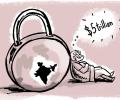
In order to achieve $5 trillion GDP by FY'25, India needs to spend about $1.4 trillion over this period on infrastructure, according to the Economic Survey. During financial years 2008-17, India pumped in about $1.1 trillion on infrastructure. However, the challenge is to step up infrastructure investment substantially, the Economic Survey 2021-22 said.
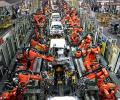
India's economy grew 6.1 per cent in the fourth quarter of 2022-23, pushing up the annual growth rate to 7.2 per cent, official data showed on Wednesday.

With Rs 17,087 crore raised so far this calendar year, the total is already 2.4 times that of the full year of 2023, which stood at Rs 7,266 crore.

The maiden, critical mineral auction in India has failed to enthuse the mining industry, with the first tranche achieving less than a 50 per cent success rate and the auction of several mines was cancelled owing to low response. The results, announced by the Ministry of Mines on Monday, showed that six lesser-known companies emerged as preferred bidders. Among these were Agrasen Sponge, Kundan Gold Mines, Dalmia Bharat Refractories, Sagar Stone Industries, and Maiki South Mining.

Capital expenditure by 54 large central public sector enterprises and five departmental arms, having a capex minimum target of Rs 100 crore, rose 93 per cent year-on-year (YoY) in the April-May period to Rs 1.39 trillion. The National Highways Authority of India (NHAI) and the Railways have started this financial year's capex cycle on a stronger note. In the first two months of FY24, the 54 CPSEs, along with the departmental arms, achieved 19 per cent of their combined budget target of Rs 7.33 trillion, Business Standard has learnt.

'More than investors, fund houses, and advisors have raised caution and limited flows on small-and mid-caps.'

India Inc on Thursday pitched for lowering income tax burden on common man, increase in capital expenditure, and firm steps to contain food inflation in their nearly two-hour long interaction with finance minister Nirmala Shitharaman ahead of the Union Budget. During pre-Budget consultation with Sitharaman, the industry leaders and associations also urged the government to focus more on infrastructure development with a view to maintaining the economic growth momentum. The industry leaders also laid stress on boosting the MSME (micro, small, and medium enterprises) sector, considered a backbone of the Indian economy and main employment generator.

'The Budget needs to focus more on social welfare schemes.'

From its lows this month, the stock of Bharti Airtel is up 14 per cent. The gains for the telco have come on the back of expectations that market share consolidation, tariff hike and lower capex should boost margins and profits. While the company is a key player in the Indian market, it also has a leadership position in major markets of Africa.

'If the majority falls short of expectations, it may prompt initial adjustments in investor sentiment.'

Smart City Mission has unleashed an unprecedented enthusiasm and expectations both within and outside the country.
Telecom operator Bharti Airtel Chairman Sunil Mittal on Wednesday said the telecom sector reforms approved by the Cabinet will ensure that the industry is able to invest fearlessly, and the company will respond to Prime Minister Narendra Modi's call to invest and accelerate the country's growth. Among a series of breathers for the stressed telecom sector, the Cabinet has approved the inclusion of revenues earned only from telecom services in the adjusted gross revenue (AGR), and the removal of penalty on dues to be paid to the government prospectively. Mittal congratulated and thanked the government for undertaking these seminal reforms to lift an industry that is at the core of his Digital India vision.

Deputy Governor Michael Patra warned about the spillover effects of food inflation.

Adani Power, part of the Adani group, plans to add close to 6 gigawatts (Gw) of new power assets in the next five years, according to an investor presentation by the company. That is clearly meant to ride on India's burgeoning power demand. But there is another side to it: All of this new capacity is expected to be thermal power, or power produced from coal.
